
Explore

Showing posts with label Costa's Hummingbird. Show all posts

Wednesday, July 9, 2014

The Science of Hummingbirds


Sometimes, when I'm scoping for MacGillivray's Warblers or peering in bushes looking for Wrentits, out of nowhere there'll be a "ZEEeeeert!" loud enough to make me jump out of my binoculars. It gets me every time, and after a closer look, the culprit-an Anna's Hummingbird- will always be sitting smugly nearby. "Darnit!" I will curse. "Hummer got me again!"
I've always been fascinated at how hummingbirds-  birds that weigh not much more than a penny, require a ridiculous amount of energy to function, and are small enough to fit in a chicken egg-manage to survive the various strains and stresses of migration, caring for young, cold nights, food, and making noises loud enough to scare humans. So I set out to reserach, google, read up, and observe on how hummingbirds survive and other interesting tidbits!

YOOOUUUU..... AGAIN.... 


Are humans going the way of the hummingbird? 

A couple months ago, I read a little snippet in the Orange County Register that said something along the lines of "the hummingbird is an example of what humans are becoming. Us humans are increasingly speeding up and being constantly busy, and cities all over the world have already sped up. In the very near future, we might easily fall into the evolutionary trap of the hummingbird."

Read on to see if that theory is just a far-fetched crackpot idea, or if it actually has some credibility.


Anatomy and the Hummingbird

One may ask, how does the hummingbird manage to do such awe-inspiring tricks like flying backwards, hovering precisely, and doing figure eights at thirty miles per hour through flaming hoops (have you ever been to the Buffalo Bill's Wild Hummingbird Show?) The answer is so ridiculously simple that you all already thought of it: it's all in the anatomy. In addition to having sockets (basically, sockets are sock rockets) that can rotate backward, most hummingbirds beat their wings at more than 130 times a second. The only thing that I can do 130 times per second is.... well, nothing.


Not just another pretty face. 


Energy Expenditure


It's hard to believe that hummingbirds almost entirely subsist upon the sugar in nectar. I'd like to know how they manage to avoid getting diabetes after all that sugar. Then consider that experiments studying the energy expenditure of hummingbirds show that hummingbirds have the highest energy expenditure and some of the highest relative body temperatures of all creatures in the entire Earth, and things get interesting. How do hummers even manage to survive?

According to the amazing book that everyone should check out, The Private Lives of Garden Birds, a hummingbird has to average about one meal per 11 seconds. Some quick calculations will tell you to keep itself from starving, an average hummingbird just trying to keep itself alive has to visit more than 3000 flowers during the daytime only-add in the factor that most flowers take hours to replenish their food supply, and that most food supplies outside of a hummingbird's territory are zealously guarded by rival hummingbirds, and the task of surviving becomes even more difficult for a hummingbird. Ugh.


If they don't drink, they die.


A bird the size of a small watch loses heat incredibly quickly-on any night less than warm, a hummingbird would quickly die, if not for torpor. Birds in general have been known to frequently fall into torpor , and sometimes even hibernation in extreme conditions, but the hummingbird in particular relies on torpor to survive every night.

Migration

Hummingbirds may not travel the longest-distance migration like the Arctic Tern, but they do embark on one of the most implausible, amazing journeys of bird-dom. Every year, instead of taking the long way round the Gulf of Mexico, many Ruby-throated Hummingbirds desperate to get to their summer location as fast as possible fly across the gulf nonstop, a journey of more than 600 miles and fraught with danger for the tiny hummingbird.


I have a secret theory that migrating Gulf hummingbirds actually ride on the back of bigger birds. Sounds legit.


In order to build enough energy for the incredible journey, a little hummingbird must build up a large fat reserve. In weeks before migration, Ruby-throated Hummingbirds can increase their weight by as much as 50% ! They must have a lot of McDonald's in South America. Still, even after they build their fuel, an average Ruby-throated Hummingbird still weighs a pitiful 0.20 ounces, and not even all the energy can be used. Apparently, this source is still more than enough to drive a hummingbird over the 600 mile gulf.  As soon as a hummingbird reaches the other side, it must eat like a beer bear on a tattle pin in order to survive. What the heck is a beer bear on a tattle pin? I have no idea


Creature Feature:

Orange-throated Hummingbirds?

It may surprise you, but many renowned ornithologists and not-so renowned birders believe that male hummingbirds have an "alternate," plumage like goldfinches! 
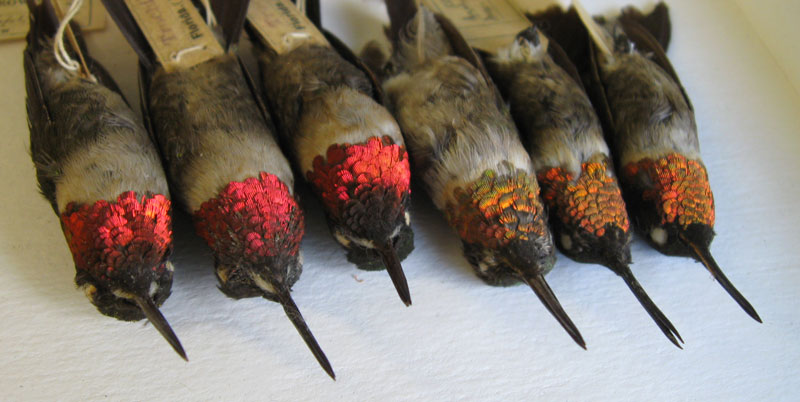


Male Ruby-throated Hummingbirds. The ones on left are"breeding plumaged,"-April and the ones on right are in "alternate plumage."-Oct-Nov

Image credits:  http://www.sibleyguides.com/wp-content/uploads/Archilochus_colubris_MCZ_20110715_107_web.jpg

If you would like to join in the discussion about this theory, then go to the above link.


So are humans going the way of the hummingbird? You decide for yourself! 


-chiccadee


Oops, wrong Hummer.


Resources
Orange-throated Hummingbirds
Hummingbird Energy Expenditure

Image Credits
Hummer (truck)
Map (Don't judge me.)

And all the other tidbits in the article came from various lectures, books, and websites that I can't remember.

Note: I know a lot of these images are rehashed from previous posts but I don't have any other ones so deal with it.


Sunday, June 15, 2014

Flight


Flight

I've always been amazed by birds' flight. If humans had wings, we would probably be crashing, blundering, and falling everywhere, being the clumsy organisms we are. But the flight of birds is graceful, quick, and complicated.

To start, I'll post an old set of photos showing the takeoff progression of a House Finch, which all takes less than 1/10 of a second. Though they're not eye-pleasing images (I filmed the takeoff, then clipped seperate images from the video) they show decently the complicated-but-simple act of taking off that birds probably do 1209803948098 times a day.

Mr. Finch has to position himself into the prime position for takeoff.


One powerful flap provides all the lift the finch will need to set him on his appropriate pathway.

A little flap helps the finch maneuver towards his goal.


He then tucks in his wings, creating the classic "bobbing" look of finch flight:

And he directs himself towards the feeder down below. 


See? A lot more complicated than it looks at first. To get to the feeder and use a minimal amount of energy, the House Finch has to use the best angle, direction, and flapagram (yes, that's a thing now) to calculate the best route to go.

A Purple Finch (The only female I ever saw at my feeders) tries to figure out how to land on my feeder without stepping on a House Finch head. 

Having a fight? Hard. Having an airborne fight? Super hard!! 


The ultraspeed flight of the hummingbird

I remember around ten years ago, some random guy at a bird show said that hummingbirds can beat their wings up to 200  times a second. I didn't buy it then because my little kiddy brain just couldn't imagine that, but I certainly believe it now! The amount of control and manipulation hummingbirds gain from their ultra fast-moving wings and small body is mind-blowing. 

Unfortunately, it also spells a shorter, harder life for the bird, and most hummingbirds don't live too long (There are a few super exceptions- A couple hummers have lived to be more than 9 years old).

Hummingbirds are the only birds that can fly backward! Males display their super-stamina and strength in extremely impressive, energy-consuming courtships that have only a small chance of winning over mates. 

Hummingbirds use their minute wing  control to hover and drink from the typical thin tubes of nectar-rich flowers. 

As well as constantly feeding to ensure that their energy level is up, hummingbirds have to constantly be on the watch to ensure no other hummingbirds are stealing food from their territory. Another hummer found on one's territory will result in an incredibly fast, exciting aerial chase.


Skilled flight of flycatchers

Imagine this. You are hungry, and there's no food left in the kitchen. So instead of cooking up a meal, you have to go about it another way instead. You stand outside in a large park. Every couple of minutes, a random chocolate chip goes flying at a hummingbird's speed through the air somewhere in the park. You must first spot it.  Then you have to run over to it and catch it with your mouth before it flies out of the park, which it will soon. Now repeat this about 1000 times a day, or starve. Oh, and if you have kids, you need to catch 5X more chocolate chips to keep them from starving. Sounds fun, right? 

In order to catch fast, small insects in the air, flycatchers have to be extremely adept at flight and have spectacular vision. 

A Say's Phoebe hovers in the air like a butterfly searching for insects. When it finds one, it will dive down on the insect and grab it. 


Phoebes seem to be on the constant watch for insects. 


Hope you enjoyed this week's post!


-chiccadee


Saturday, May 31, 2014

The Rainbow of Summer (Photo Blog #2)

All logos on this post were created by cooltext.com


THE WINGED RAINBOW OF SUMMER
Summer in Southern California means vibrant reds, pretty yellows, and beautiful blues to birders. Here are seven common colorful visitors from the tropics that can be seen here. 


Western Tanager (backyard)

Fast fact: Western Tanagers obtain their red-colored head from rhodoxathin, without their specialized diet they'd lose it. 


Black-headed Grosbeak (backyard) 

Fast Fact: Black-headed Grosbeaks are one of the few birds that are immune to monarch butterfly toxin and often feed on them. 


Yellow-breasted Chat (Golf course)


Fast fact: Chats mimic other birds in their rattling, loud songs.


Yellow Warbler (park) 

Fast fact: The oldest Yellow Wabler recorded in the wild lived to be 11, which is longer than the longest recorded life span of a Western Tanager by five years. 


Orange-crowned Warbler (outside bushes of a building)

Fast fact: The Orange-crowned Warbler is one of the most geographically diverse warblers in North America.


Blue Grosbeak (Aliso Woods)

Fast Fact: Blue Grosbeaks seen in Orange County and other areas in the West Coast migrate directly over the Gulf of Mexico! 


Costa's Hummingbird (campground area)

Fast Fact: The heart rate of Costa's Hummingbirds vary from 50 times for minute when the bird is torpid to 900 times a minute when the bird is fully active (Soruce: Cornell Lab of Ornithology ) 

Sunday, May 11, 2014

Celebrate P&S Power!

IT'S OFFICIAL POINT-AND-SHOOT CAMERA DAY!
(If that sounds made up, it's because it is)


WARNING: If you have no interest in taking photos of birds whatsoever, and you read this post, you will be so bored you will shoot yourself. HAHAHA. Get it? You shoot stuff with cameras? Fortunately, I'll insert random pictures of birds I shot with my P&S camera.

Too often, I hear people complaining about their P&S cameras.

"I wish I had a DSLR! I would be so much better at photography."

"These pictures would come out SOOOOO much better with a DSLR!"

"I would take good pictures, but I don't have a DSLR."

The above statements are complete BS. BS means Ballerina Spins, for those of you who don't know. Of course, a GOOD photographer would take MUCH better photos with better DSLR equipment, but having good equipment does not make you a good photographer.

DSLR cameras are superior to point-and-shoots in many, many ways. It would take hours to count them all.
Unfortunately, most of us really just can't afford quality DSLRs.
So, let's celebrate National P&S Day by listing some of the things that make P&S cameras better than DSLRS!


1. Point-and-shoot cameras are waaaay cheaper than DSLRs.
Quality wildlife photography DSLRs are typically 2X more expensive than 2X the cost of a cheaper DSLR which is 3X the cost of the best P&S camera available, which is 500X the amount of money I have.

2. You can go incognito.

You can sneak tiny little P&S cameras with their tiny little lens to boring events like soccer games and not look suspicious while you're secretly taking pictures of birds! Going to a soccer game with a DSLR is just too obvious.


3. You're less likely to get robbed.

Criminals look at a DSLR telephoto lens are immediately think of money. They look at P&S cameras and immediately think of bad experiences of trying to take pictures of butterbutts.

Seriously, who has not gone insane trying to get shots of these guys?

4.You're less likely to get tendinitis if using a point-and-shoot.

Lugging and lifting a huge lens can cause some serious arm strain, especially if you take lots of pictures. Actually, not really. It just creates a tiny bit more arm strain that leads to a 0.01% increased risk for tendinitis.

5. P&S is a cooler abbreviation.

Just look at that! P&S sounds more like M&M, or some kind of awesome candy company to people who have no clue about photography. DSLR sounds like a huge, clunky, machine that requires 200 years for assembly, and to figure out how to use.


Hope you enjoyed this week's celebration!

-chiccadee