Explore

Showing posts with label Allen's Hummingbird. Show all posts

Monday, June 1, 2015

Become An Ornithologist 101

I'm no Fatbirder.com, but here are some bomb-de-ziggity birding resources to spice your birding career up. Not my usual type of post, but I'm on a roll of "not-usually-my-type" posts this week. 

Everyone knows good ol' eBird:  where excited beginner birders submit checklists purporting that they had X amount of Code-4-something-something and promptly become embarrassed by their local reviewers ( I totally don't know that from experience. Um. ). Other websites, like allaboutbirds.org, fatbirder.something, and the ABA blog are also excessively discussed by birders as a leaning point for cool bird sites. The websites down below? Not so much.


1. Xeno-canto: "Sharing bird sounds from all around the world."

http://www.xeno-canto.org/


I hate to sound blithely ignorant,  but I'm not quite sure what xeno-canto refers to either (NEITHER DO YOU, ADMIT IT). According to the best of my ability of Googling skills, Xeno-canto translates to "foreigner- one of the sections into which some long poems are divided." I'm sure there's some poetic backwater meaning or, which would have been the motive in my case, the founders just chose it because it sounds cool. Whatever its meaning, it will retain a place in my mind reserved for cryptic and puzzling mysteries: probably not what they intended, but overanalytical people like me suffer it as a side effect.

"Foreigner- one of the sections into which some long poems are divided" is a website worthy of my one pathetic recording of a Purple Finch, a bird which serves as an apt warning to not let colorblind people name birds after colors. 


2. Avibase: "The World Bird Database." http://avibase.bsc-eoc.org/avibase.jsp?lang=EN

Whoever founded this site had a lot of time on their hands. In other words, definitely not a college student (watch him/her be a college student and angrily digress on this post). Anyhow, they have all their checklists narrowed down to country, province, whatever...maybe they could collaborate with the NSA to provide custom checklists for your backyard,  personal address, or internet searches, too, if the site wasn't based in Canada.

It's an accurate, refreshing site with its own highly liberal taxonomy system that I love and will maybe one day adopt as my world taxonomy system once anyone within a 100-mile radius of here accepts any of its glamour. Oh hey look! Cool: http://avibase.bsc-eoc.org/compare.jsp


3. HBW Alive: "A revolution in ornithological reference works(Exclamation mark!!)"

"What the hell man," all the angry readers of this post exclaimed simultaneously. "You ain't supposed to be advertising on here." Well, I'm not advertising, but HBW Alive is TOTALLY WORTH THE PRICE AND IF YOU CALL 
GIVE-MEMY-$SCAM NOW I'LL GIVE YOU TWO COPIES OF THE WEBSITE AND A PIECE OF LAND ON MARS!  Just watch the video on the site for god's sake and tell me you're a birder and not convinced.

I was convinced but I don't have the money for that, so instead of finding some way to pirate a free version, I asked by parents. There's free functions, too, for the decidedly un-self-indulgent. 


4. The Birds of North America Online: "Welcome. Ladder-backed Woodpecker Photo by Rick and Nora."

Great...another damn thing you have to pay for?? You're birders. You're in the top 5% of the wealth histogram. Don't tell me a full-time worker at McDonalds with three kids can afford binoculars, scope, AND a camera. 

I'm not subscribed to this. I didn't even ask. The prices made me cringe a tiny bit on my future-college-student-insides. Even though I'm receiving $1700 worth in camera gear this week.  But it's a fantastic resource, more than you'll ever absorb in a year of $42, which is how they make money, probably: by being too fantastic to function.


 5. Chiccadee: For the Birds (and the birders): "Insert Creative Motto Here!"

Follow it if you know what's good for you.


-chiccadee


Wednesday, July 9, 2014

The Science of Hummingbirds


Sometimes, when I'm scoping for MacGillivray's Warblers or peering in bushes looking for Wrentits, out of nowhere there'll be a "ZEEeeeert!" loud enough to make me jump out of my binoculars. It gets me every time, and after a closer look, the culprit-an Anna's Hummingbird- will always be sitting smugly nearby. "Darnit!" I will curse. "Hummer got me again!"
I've always been fascinated at how hummingbirds-  birds that weigh not much more than a penny, require a ridiculous amount of energy to function, and are small enough to fit in a chicken egg-manage to survive the various strains and stresses of migration, caring for young, cold nights, food, and making noises loud enough to scare humans. So I set out to reserach, google, read up, and observe on how hummingbirds survive and other interesting tidbits!

YOOOUUUU..... AGAIN.... 


Are humans going the way of the hummingbird? 

A couple months ago, I read a little snippet in the Orange County Register that said something along the lines of "the hummingbird is an example of what humans are becoming. Us humans are increasingly speeding up and being constantly busy, and cities all over the world have already sped up. In the very near future, we might easily fall into the evolutionary trap of the hummingbird."

Read on to see if that theory is just a far-fetched crackpot idea, or if it actually has some credibility.


Anatomy and the Hummingbird

One may ask, how does the hummingbird manage to do such awe-inspiring tricks like flying backwards, hovering precisely, and doing figure eights at thirty miles per hour through flaming hoops (have you ever been to the Buffalo Bill's Wild Hummingbird Show?) The answer is so ridiculously simple that you all already thought of it: it's all in the anatomy. In addition to having sockets (basically, sockets are sock rockets) that can rotate backward, most hummingbirds beat their wings at more than 130 times a second. The only thing that I can do 130 times per second is.... well, nothing.


Not just another pretty face. 


Energy Expenditure


It's hard to believe that hummingbirds almost entirely subsist upon the sugar in nectar. I'd like to know how they manage to avoid getting diabetes after all that sugar. Then consider that experiments studying the energy expenditure of hummingbirds show that hummingbirds have the highest energy expenditure and some of the highest relative body temperatures of all creatures in the entire Earth, and things get interesting. How do hummers even manage to survive?

According to the amazing book that everyone should check out, The Private Lives of Garden Birds, a hummingbird has to average about one meal per 11 seconds. Some quick calculations will tell you to keep itself from starving, an average hummingbird just trying to keep itself alive has to visit more than 3000 flowers during the daytime only-add in the factor that most flowers take hours to replenish their food supply, and that most food supplies outside of a hummingbird's territory are zealously guarded by rival hummingbirds, and the task of surviving becomes even more difficult for a hummingbird. Ugh.


If they don't drink, they die.


A bird the size of a small watch loses heat incredibly quickly-on any night less than warm, a hummingbird would quickly die, if not for torpor. Birds in general have been known to frequently fall into torpor , and sometimes even hibernation in extreme conditions, but the hummingbird in particular relies on torpor to survive every night.

Migration

Hummingbirds may not travel the longest-distance migration like the Arctic Tern, but they do embark on one of the most implausible, amazing journeys of bird-dom. Every year, instead of taking the long way round the Gulf of Mexico, many Ruby-throated Hummingbirds desperate to get to their summer location as fast as possible fly across the gulf nonstop, a journey of more than 600 miles and fraught with danger for the tiny hummingbird.


I have a secret theory that migrating Gulf hummingbirds actually ride on the back of bigger birds. Sounds legit.


In order to build enough energy for the incredible journey, a little hummingbird must build up a large fat reserve. In weeks before migration, Ruby-throated Hummingbirds can increase their weight by as much as 50% ! They must have a lot of McDonald's in South America. Still, even after they build their fuel, an average Ruby-throated Hummingbird still weighs a pitiful 0.20 ounces, and not even all the energy can be used. Apparently, this source is still more than enough to drive a hummingbird over the 600 mile gulf.  As soon as a hummingbird reaches the other side, it must eat like a beer bear on a tattle pin in order to survive. What the heck is a beer bear on a tattle pin? I have no idea


Creature Feature:

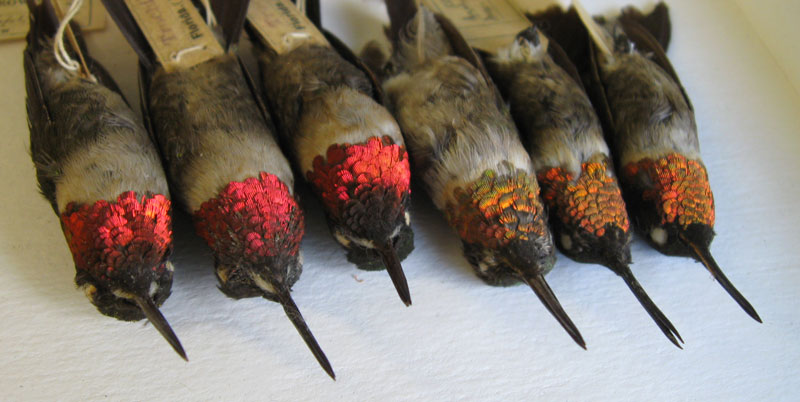
Orange-throated Hummingbirds?

It may surprise you, but many renowned ornithologists and not-so renowned birders believe that male hummingbirds have an "alternate," plumage like goldfinches! 


Male Ruby-throated Hummingbirds. The ones on left are"breeding plumaged,"-April and the ones on right are in "alternate plumage."-Oct-Nov

Image credits:  http://www.sibleyguides.com/wp-content/uploads/Archilochus_colubris_MCZ_20110715_107_web.jpg

If you would like to join in the discussion about this theory, then go to the above link.


So are humans going the way of the hummingbird? You decide for yourself! 


-chiccadee


Oops, wrong Hummer.


Resources
Orange-throated Hummingbirds
Hummingbird Energy Expenditure

Image Credits
Hummer (truck)
Map (Don't judge me.)

And all the other tidbits in the article came from various lectures, books, and websites that I can't remember.

Note: I know a lot of these images are rehashed from previous posts but I don't have any other ones so deal with it.


Sunday, June 15, 2014

Flight


Flight

I've always been amazed by birds' flight. If humans had wings, we would probably be crashing, blundering, and falling everywhere, being the clumsy organisms we are. But the flight of birds is graceful, quick, and complicated.

To start, I'll post an old set of photos showing the takeoff progression of a House Finch, which all takes less than 1/10 of a second. Though they're not eye-pleasing images (I filmed the takeoff, then clipped seperate images from the video) they show decently the complicated-but-simple act of taking off that birds probably do 1209803948098 times a day.

Mr. Finch has to position himself into the prime position for takeoff.


One powerful flap provides all the lift the finch will need to set him on his appropriate pathway.

A little flap helps the finch maneuver towards his goal.


He then tucks in his wings, creating the classic "bobbing" look of finch flight:

And he directs himself towards the feeder down below. 


See? A lot more complicated than it looks at first. To get to the feeder and use a minimal amount of energy, the House Finch has to use the best angle, direction, and flapagram (yes, that's a thing now) to calculate the best route to go.

A Purple Finch (The only female I ever saw at my feeders) tries to figure out how to land on my feeder without stepping on a House Finch head. 

Having a fight? Hard. Having an airborne fight? Super hard!! 


The ultraspeed flight of the hummingbird

I remember around ten years ago, some random guy at a bird show said that hummingbirds can beat their wings up to 200  times a second. I didn't buy it then because my little kiddy brain just couldn't imagine that, but I certainly believe it now! The amount of control and manipulation hummingbirds gain from their ultra fast-moving wings and small body is mind-blowing. 

Unfortunately, it also spells a shorter, harder life for the bird, and most hummingbirds don't live too long (There are a few super exceptions- A couple hummers have lived to be more than 9 years old).

Hummingbirds are the only birds that can fly backward! Males display their super-stamina and strength in extremely impressive, energy-consuming courtships that have only a small chance of winning over mates. 

Hummingbirds use their minute wing  control to hover and drink from the typical thin tubes of nectar-rich flowers. 

As well as constantly feeding to ensure that their energy level is up, hummingbirds have to constantly be on the watch to ensure no other hummingbirds are stealing food from their territory. Another hummer found on one's territory will result in an incredibly fast, exciting aerial chase.


Skilled flight of flycatchers

Imagine this. You are hungry, and there's no food left in the kitchen. So instead of cooking up a meal, you have to go about it another way instead. You stand outside in a large park. Every couple of minutes, a random chocolate chip goes flying at a hummingbird's speed through the air somewhere in the park. You must first spot it.  Then you have to run over to it and catch it with your mouth before it flies out of the park, which it will soon. Now repeat this about 1000 times a day, or starve. Oh, and if you have kids, you need to catch 5X more chocolate chips to keep them from starving. Sounds fun, right? 

In order to catch fast, small insects in the air, flycatchers have to be extremely adept at flight and have spectacular vision. 

A Say's Phoebe hovers in the air like a butterfly searching for insects. When it finds one, it will dive down on the insect and grab it. 


Phoebes seem to be on the constant watch for insects. 


Hope you enjoyed this week's post!


-chiccadee


Monday, April 21, 2014

Homage to Hummers


The hummingbird is made of jewels and glass
A million embedded in its miniature body
Obsidian eyes and paper-thin emeralds
Enclasp the delicate feather's sheen

Billions of rainbows bounce off 
A hummingbird's body, shimmering
And glittering like some sort of fantastic alien


The hummingbird was dipped
 in hundreds of pools
 of gold, silver and copper
And all sorts of other strange iridescent liquids
From different planets 
That shift and sliver like a snake
From color to color to color

Some hummingbirds have twisted canes
Dangling from their tail, with a bead of sapphire at the tip
Others have magic discs
A thousand shades of turquoise and green
And laced with glitter
Hanging from their ends. 


The lanky lance of the hummingbird
is sometimes curved like a crescent moon,
sometimes it slips like a sickle
sometimes, 
the hummingbird has 
Wires coming out of its head.

And yet, with the heavy burden of grace
hummingbirds are bullets
Powered with energy like a shotgun
Maneuverable to the last millisecond.
A falcon in the spirit, a quetzal in the body


All the colors in the rainbow
are not enough to describe the beauty of the hummingbirds


In southern California, we don't get very many hummingbirds. The ones we do are certainly beautiful, but are dwarfed by the legendary hummingbirds of Ecuador, 135 in total. Their names are set in stone in the birding myths of North America: the Booted Racket-tail, Violet-tailed Sylph, Velvet-purple Coronet, Sapphire-vented Puffleg, Wire-crested Forktail, and a ton of others. I say "myth," because whenever some birder comes back from South America  with photos of these hummingbirds and declares he/she has seen those birds, everyone is so overwhelmed with jealousy that they can't believe it. Literally. 


Not the best picture but it really shows the fire of the male's gorgets.

I guess I really shouldn't be complaining because after all, hummingbirds can only be found in the Americas and the ones I get are beautiful.

All this talk about hummingbirds reminds me of an old Indian myth my first-grade teacher told me about the strength and magic of hummingbirds! I have no idea how close my version is to the actual tale, as it is based on memory and my imagination only.

When the world was new and the air was full of dew, all the animals of planet Earth got along with each other. For nourishment, all settled on grass and vegetation as it was the only substance that was readily available and would keep the animals in good health, and the Goddess of the Earth demanded that it stay this way. The sun shone all day and there was no night, and for a long, long time, life was peaceful. 

Of course, some animals were not content. They tired of grass and flowers and leaves, and wished to try something new.

Brown Bear went to the river and decided by himself to kill and eat the salmon. After sampling, he discovered it was ravishingly tasty and told the other animals.  

"Coyote, try the salmon. It is delicious and satisfying."

Coyote could not catch the slippery salmon with his blunt claws, so he chased the Jack-rabbits until he caught and ate one. The Jackrabbits and the Salmon complained to the Goddess of the Earth and Skies. The Goddess became angry.

"From now on to eternity, the Earth shall become as dark as a rabbit-hole to punish the creatures of Earth for their insolence!"

And she was true to her word. The goddess placed a pitch-black curtain over the sky to block the sun out. For many, many months, the Earth was indeed as dark as a rabbit-hole. The animals were miserable and sorry. The most miserable of all was Hummingbird, who called a meeting to the lowest valley in the lands to decide what was to be done.

"One of us birds should fly up to the blanket and rip it in half!" Pheasant proposed.

"But who is strong enough to do that?" Everyone else rejected the plan.

Only Hummingbird, the tiniest of all birds, a mere speck nest to Pheasant, responded, "I will do it."

And she flew up to the highest mountain peak, and flew even higher from there, until she reached the blanket, and she poked it once before her strength gave out and she fell back to Earth. 

But Hummingbird would not give up. Again and again she flew, up, up, and up, and each time she fell back down, until there were thousands of tiny white specks in the blanket where daylight fell through.

On the last time, Hummingbird again flew. As fast as as a storm she flew, past the clouds and the cold, and this time she ripped open a huge, round hole. Alas, all the flying was too much for her and she dropped down and fell dead.

The goddess was so impressed and moved by the courage and strength of Hummingbird she announced that from now on she would place the blanket on every 12 hours, and take it off again every 12 hours. 

And that is the story of how Hummingbird created the moon and stars, and why we now have day and night. 


-chiccadee

Nest!


Monday, April 7, 2014

Backyard Bird Photoshoot!

Backyard Bird Photoshoots

Sometimes, when the air is warm and the breeze is soft, I like to sit for a half-hour or so roaming around my tiny, messy backyard and shooting birds.

I really like to shoot birds. It's one of my favorite activities. Especially when you shoot a really rare or beautiful bird!

With a camera, of course (In all probability, someone is going to read just the above three sentences and go on a two-hour rant). Despite what people think, point-and-shoots can take good pictures.

Lesser goldfinches are one of my favorite subjects. 
This big, bad, goldfinch isn't afraid of the thorn bush!

Lesser Goldfinches are plain but beautiful at the same time.


Hummers come up next. 
Half of the photos I take in the backyard are of hummingbirds. 

This little, bad, hummer isn't afraid of the thorn bush either. 
A male Allen's Hummingbird shows off his gorgeous gorgets to the ladies. 

To take this shot, I had to learn the habits and timing of this feisty little male. 


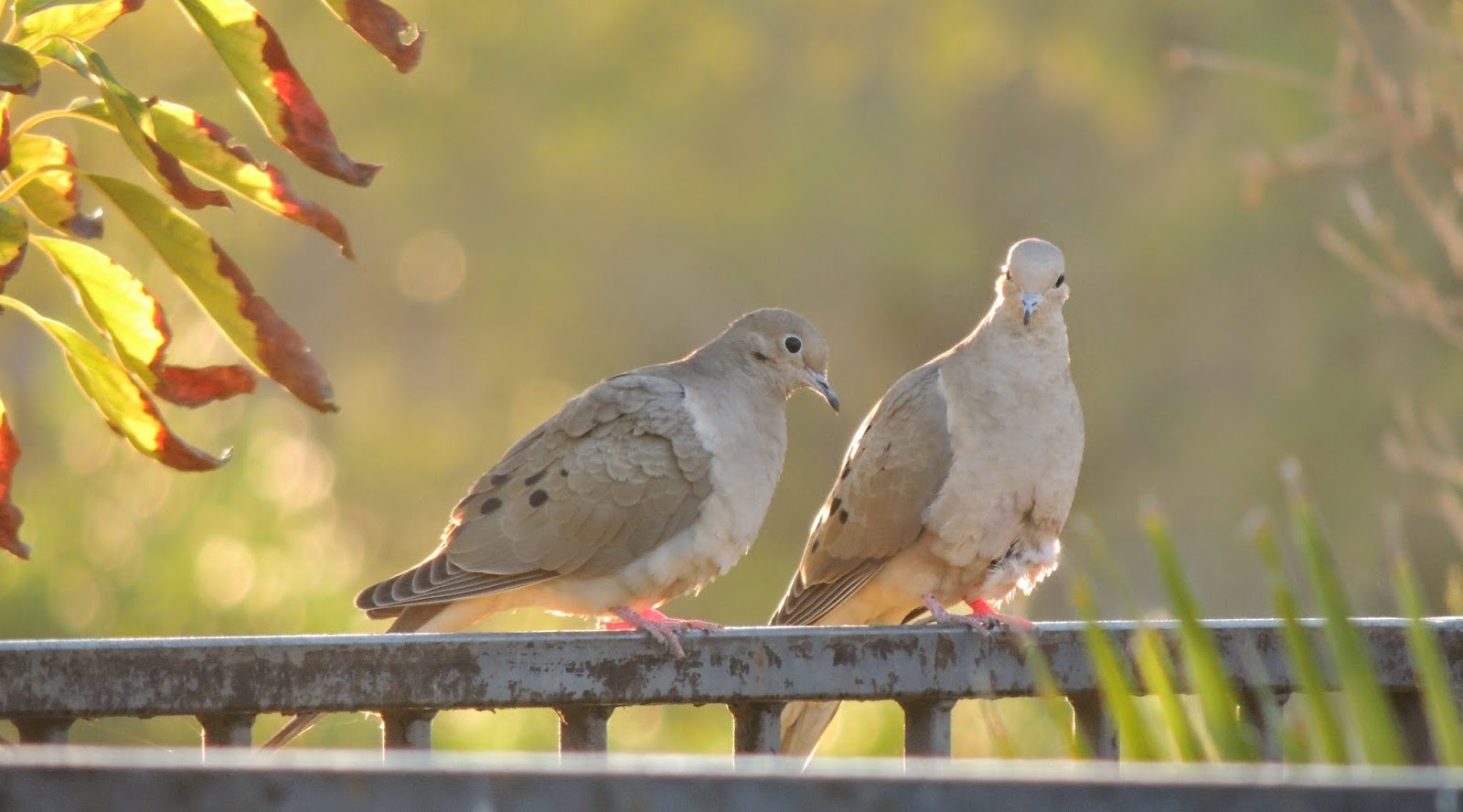
Last but not least, the beloved MODO! 

This pair shamelessly gets into it all the time on my fence.


Next time you're tired and don't want to go anywhere, why not just take a chair, grab a camera, sit outside, and start watching and taking photos of birds?


-chiccadee